
Microneedle Drug Delivery CRO/CDMO
Hours: 8:30 AM–5:30 PMSales: +86 10 8928 7035Business: bd@casmn.com

MICRONEEDLE TECHNOLOGY

Coated Microneedle Technology

Coated microneedles use a solid microneedle substrate with a payload-containing surface layer, enabling localized loading and release after insertion.
01

What Are Coated Microneedles?

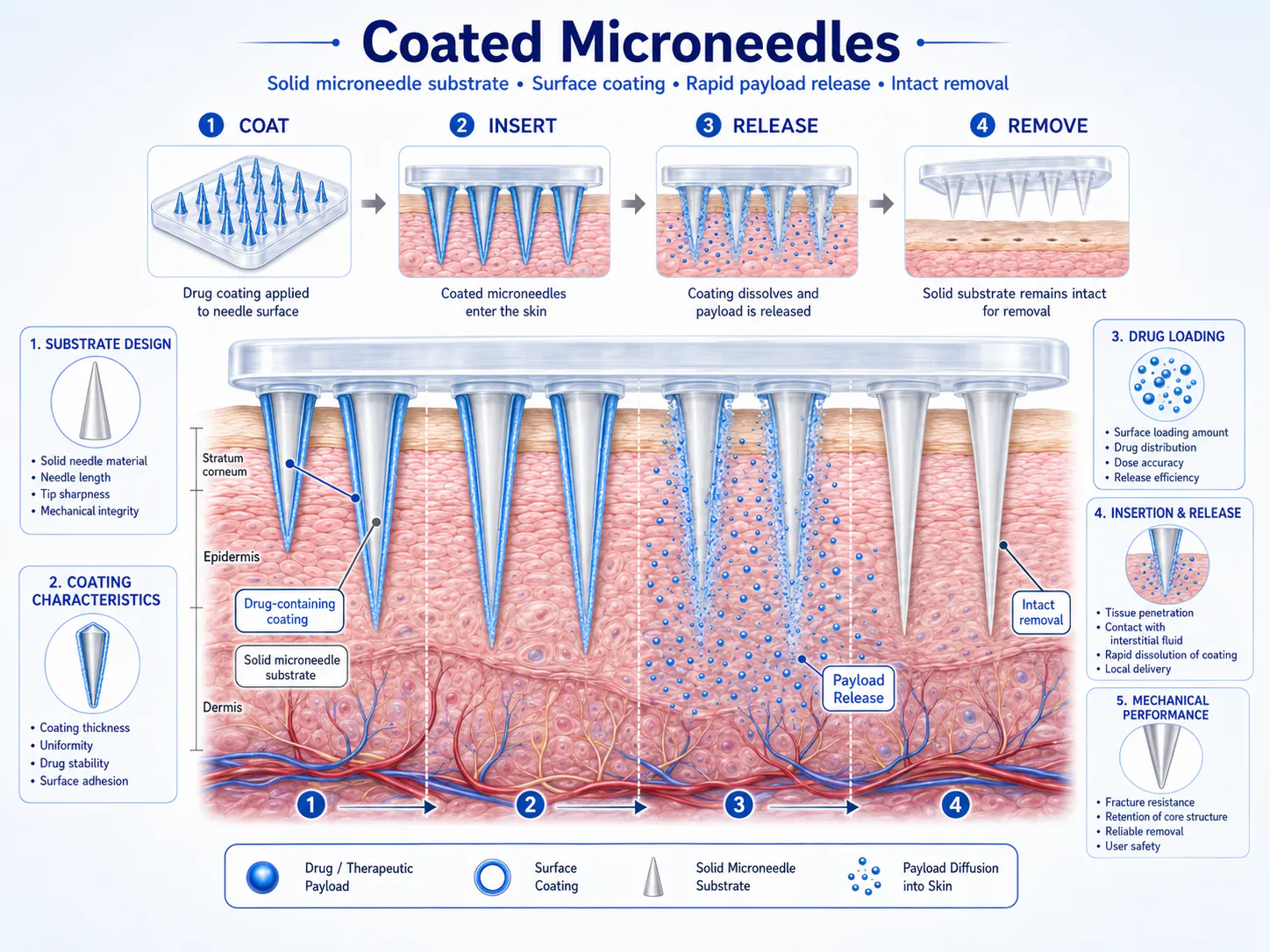
Coated microneedles consist of a solid microneedle substrate carrying a drug-containing coating on the needle surface. After insertion, the coating contacts tissue fluid and releases the payload while the underlying microneedle structure remains intact for removal.
02

How Coated Microneedles Work

Coating preparation → surface coating → skin insertion → coating dissolution and release → removal of the intact microneedle structure. Each step is developed around the selected payload, target product profile and handling requirements.

How Coated Microneedles Work
03

Coating Formulation and Payload Loading

Because payload is primarily located on the needle surface, coating formulation and loading are central development questions. Solids content, viscosity, surface tension, excipients, payload concentration, stability and coating behaviour are assessed together.

04

Dose Capacity and Coating Uniformity

Available needle surface area, coating thickness, payload concentration, spatial distribution and unit-to-unit consistency together determine practical dose capacity and dose-control objectives.

05

Coating Adhesion and Insertion Performance

The coating must retain appropriate adhesion during handling, storage and insertion, while still releasing after application. Needle strength, coating thickness, insertion behaviour and coating loss are evaluated together.

06

Release and Delivery Performance

Coated microneedles may support rapid-release designs, but actual release and delivery behaviour depend on formulation, coating architecture, payload and intended use. Project-specific methods can assess release behaviour, residual coating and delivery performance.

07

Process Development and Scale-Up

Coating preparation, application, drying, environmental conditions, batch hold time, equipment geometry and in-process controls are developed together to support reproducibility and scale-up consistency.

08

Suitable Payloads and Development Scenarios

Coated systems are often considered for potent, relatively low-dose payloads and rapid-release concepts, including selected vaccine or biologic research programs where appropriate. Suitability cannot be determined by payload class alone; dose, stability, coating capacity, delivery requirements and manufacturing feasibility require project-specific assessment.

09

Selected Research

CASMN team research includes controlled coating methods and gel-encapsulated coated microneedles for biopharmaceutical delivery. Published research is supporting scientific evidence and does not by itself establish product performance or commercial readiness.

DOI: 10.1016/j.ajps.2021.05.002 · View DOI ↗

Technical Review — Reviewed by: CASMN R&D Team · Last reviewed: August 2026.

Related Technologies and Applications

Vaccines→Biologics→

Frequently Asked Questions

What limits the dose of a coated microneedle?

Available surface area, coating thickness, payload concentration, uniformity and insertion performance all influence practical dose capacity.

Is coated microneedle delivery always immediate?

Coated systems often support rapid release, but actual performance depends on formulation, coating design and the target application.

How is coating consistency evaluated?

Project-specific methods can assess coating mass, distribution, content and unit-to-unit variability.

Request a Technology Assessment

Send your target product, payload, development stage and cooperation scope to our business development team.

Start a Project