
Microneedle Drug Delivery CRO/CDMO
Hours: 8:30 AM–5:30 PMSales: +86 10 8928 7035Business: bd@casmn.com

MICRONEEDLE TECHNOLOGY

Dissolving Microneedle Technology

Dissolving microneedles are water-soluble or biodegradable microstructures developed to insert into the skin, dissolve after application and release an incorporated payload.
01

What Are Dissolving Microneedles?

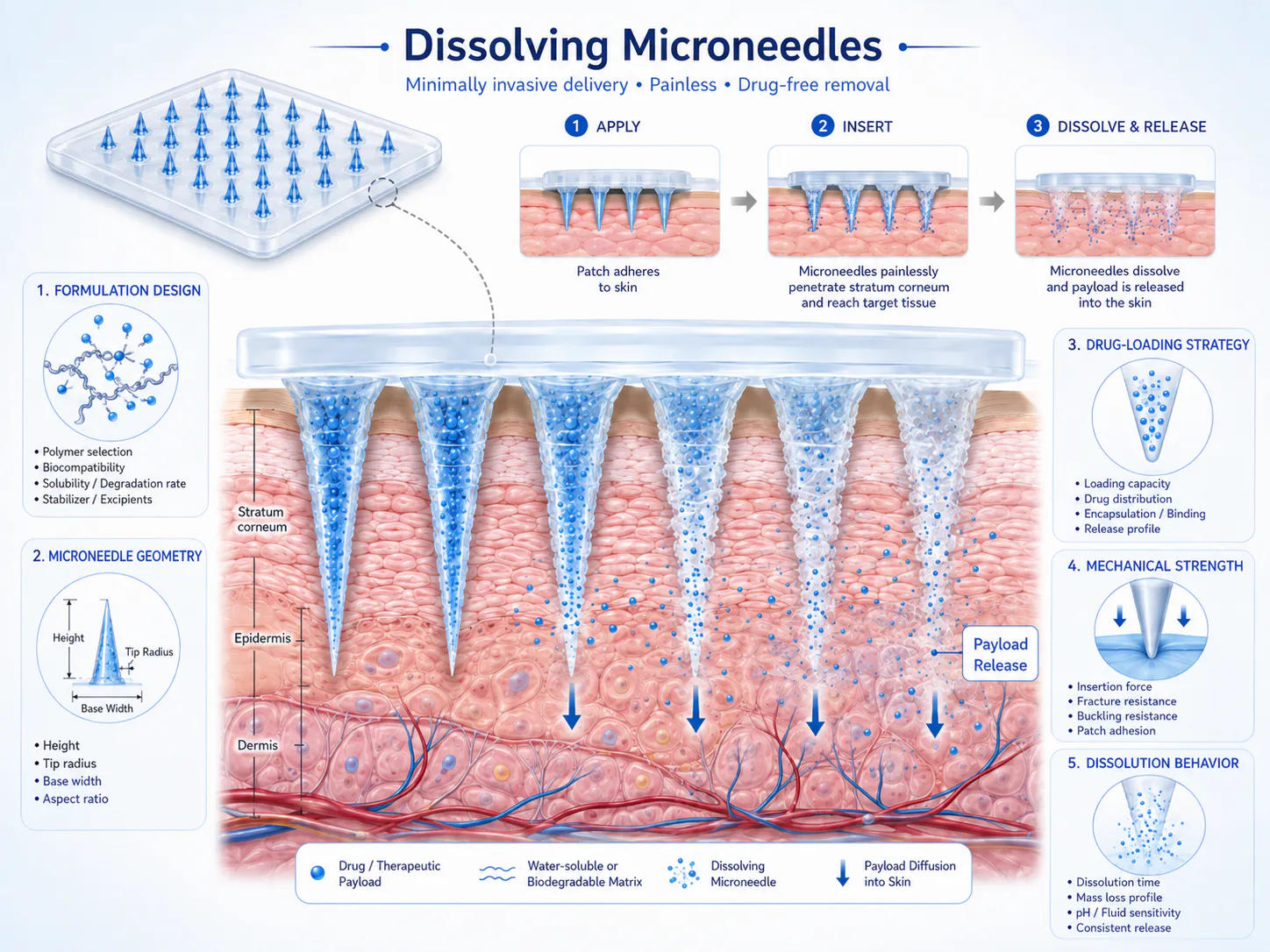
Dissolving microneedles are arrays of water-soluble or biodegradable microstructures designed to insert into the skin and dissolve after application, releasing the incorporated payload. Their performance depends on the combined design of the formulation, microneedle geometry, drug-loading strategy, mechanical strength and dissolution behavior.
02

How Dissolving Microneedles Work

Application → skin insertion → microneedle dissolution → payload release → patch or residual-backing removal. The defining feature is that moisture in the skin progressively hydrates and dissolves the microneedle matrix, enabling release of the incorporated payload.

How Dissolving Microneedles Work
03

Material and Formulation Considerations

Material selection and formulation development consider water-soluble polymers, polymer molecular weight, mechanical strength, dissolution behavior, moisture sensitivity, payload compatibility and formulation stability.

04

Drug Loading and Structural Design

Payload may be distributed homogeneously through the needle, concentrated toward the tip, incorporated into a layered or multi-layer architecture, or paired with a separable backing layer. Layered or tip-loaded architectures are possible design options when a project requires greater control over payload localization, dose efficiency or release behavior. Selection depends on dose, stability, payload characteristics and manufacturing feasibility.

  • Homogeneous loading
  • Tip-focused loading
  • Layered microneedles
  • Multi-layer designs
  • Backing-layer separation
05

Mechanical and Dissolution Performance

Needle geometry, matrix composition, residual moisture and backing design influence insertion strength, structural integrity and dissolution. Project-appropriate testing evaluates mechanical performance, skin insertion, dissolution time and release behavior.

06

Analytical and Performance Evaluation

Evaluation is selected for the development stage and may address content distribution, morphology, mechanical performance, insertion, dissolution, release and formulation stability. The objective is to support development decisions rather than to make a universal performance claim.

07

Development and Scale-Up Considerations

Payload stability, moisture and temperature sensitivity, mixing, filling, drying, demolding, backing, assembly and packaging are developed as one connected process. Scale-dependent risks and manufacturing feasibility are evaluated before process transfer.

08

Suitable Development Scenarios

Dissolving systems can be assessed for projects where a water-soluble or biodegradable matrix and payload release from the dissolving structure align with the target product profile. Dose, stability, payload characteristics, delivery requirements and manufacturing feasibility require project-specific evaluation.

09

Selected Research

CASMN team publications include dissolving microneedle studies involving peptides, proteins, vaccines, dermatology payloads and sustained-release structures. Two-layer and layered microneedle research is presented as a selected structural research example, not as the definition or standard form of dissolving microneedles.

DOI: 10.3390/pharmaceutics14061255 · View DOI ↗

  • Liu H, Zhang S, Zhou Z, Xing M, Gao Y. Two-Layer Sustained-Release Microneedles Encapsulating Exenatide for Type 2 Diabetes Treatment. Pharmaceutics. 2022;14:1255.

Technical Review — Reviewed by: CASMN R&D Team · Last reviewed: August 2026.

Related Technologies and Applications

Peptides & Proteins→Long-Acting Delivery→

Frequently Asked Questions

Can every water-soluble payload be formulated into dissolving microneedles?

No. Dose, stability, matrix compatibility, mechanical performance and delivery requirements must be evaluated together.

Can dissolving microneedles support layered loading?

Layered or tip-concentrated designs can be evaluated as one structural option when appropriate for the payload and target product profile.

What information is needed for an initial assessment?

Non-confidential payload properties, target dose, intended use, available stability data and the target development stage are useful starting inputs.

Evaluate Your Molecule

Send your target product, payload, development stage and cooperation scope to our business development team.

Start a Project